Zero Trust Architecture - A Practical Implementation Guide
A comprehensive guide to understanding and implementing Zero Trust security architecture in modern enterprise environments.
What Is Zero Trust Architecture?
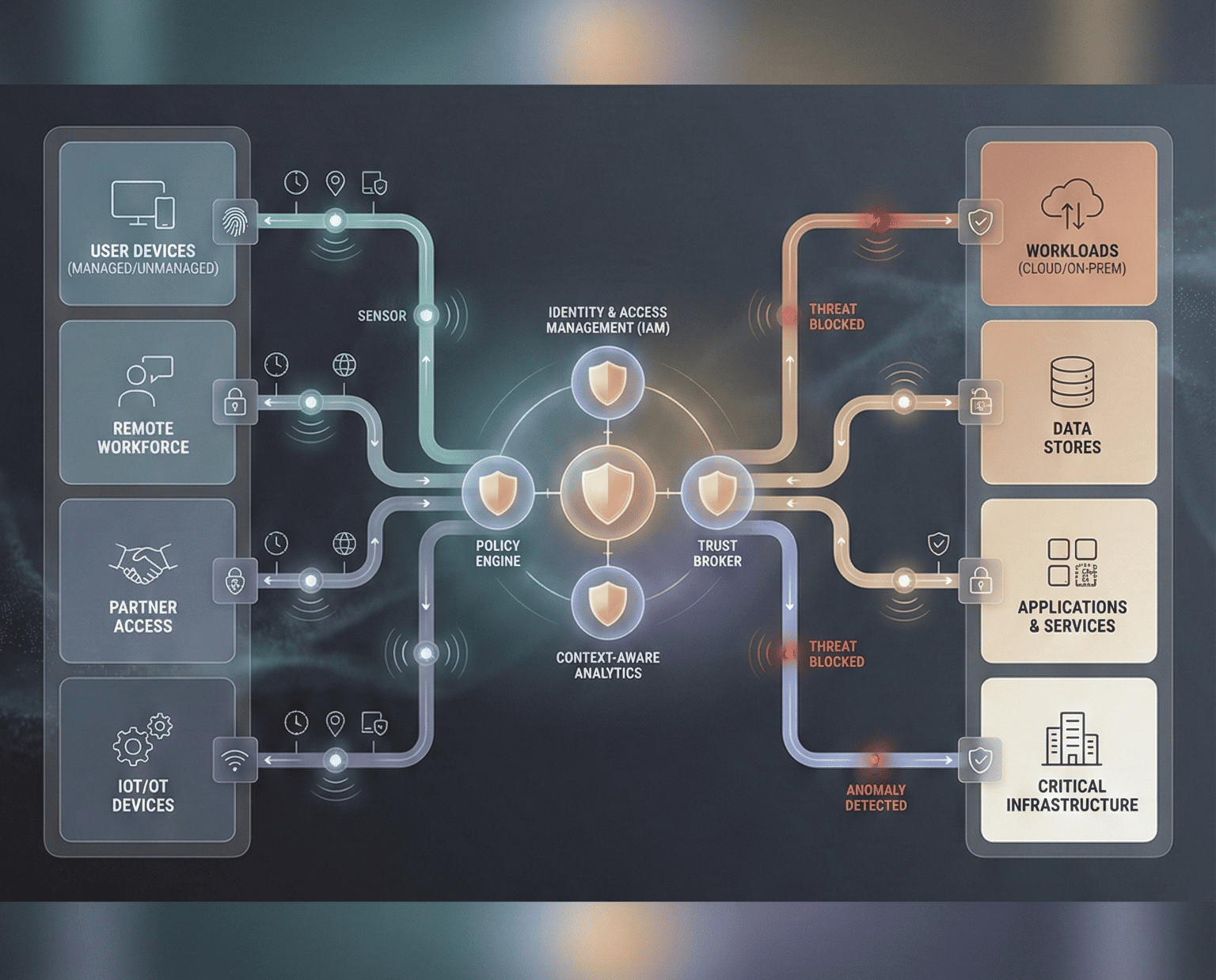
Zero Trust Architecture (ZTA) is a security model built on one fundamental principle: “Never trust, always verify.” Unlike traditional security models that assume everything inside the corporate network is trustworthy, Zero Trust treats every access request as if it originates from an untrusted network — regardless of where the request comes from or what resource it accesses.
The concept was first coined by Forrester Research analyst John Kindervag in 2010, but it gained mainstream adoption after the NIST published Special Publication 800-207 in 2020, providing a formal framework for implementation.
In a Zero Trust model, no user, device, or application is inherently trusted. Every interaction must be authenticated, authorized, and continuously validated before granting access to resources.
Why Traditional Perimeter Security Fails
The legacy “castle and moat” approach to security assumes that threats exist outside the network and that internal traffic is safe. This model has several critical weaknesses:
- Lateral movement: Once an attacker breaches the perimeter, they can move freely across the internal network. High-profile breaches like the SolarWinds attack demonstrated exactly this flaw.
- Remote work: The modern workforce operates from home networks, coffee shops, and airports. There is no defined perimeter to defend.
- Cloud adoption: Organizations now use multi-cloud environments, SaaS applications, and hybrid infrastructure that exist outside the traditional perimeter.
- Insider threats: Malicious or compromised insiders already have access within the perimeter, bypassing perimeter defenses entirely.
- BYOD and IoT: Personal devices and IoT sensors connect to corporate resources, expanding the attack surface far beyond what a firewall can protect.
These realities make it clear that perimeter-based security is no longer sufficient. Zero Trust addresses these gaps by shifting the focus from network location to identity and context.
Core Principles of Zero Trust
1. Identity Verification
Every user, device, and service must prove its identity before accessing any resource. This goes beyond simple username/password authentication:
# Example: Azure AD Conditional Access Policy
policy:
  name: "Require MFA for all users"
  conditions:
    users:
      include: "All Users"
    platforms:
      include: ["iOS", "Android", "Windows", "macOS", "Linux"]
    locations:
      include: "All Locations"
      exclude: "Trusted Office IPs"
  grant_controls:
    operator: "AND"
    built_in_controls:
      - "mfa"
      - "compliant_device"
  session_controls:
    sign_in_frequency: "4 hours"
Multi-factor authentication (MFA), device certificates, and behavioral biometrics all contribute to building strong identity assurance.
2. Least Privilege Access
Users and services should only have access to the specific resources they need to perform their job — nothing more. This minimizes the blast radius if credentials are compromised.
# Example: AWS IAM Policy following least privilege
{
  "Version": "2012-10-17",
  "Statement": [
    {
      "Effect": "Allow",
      "Action": [
        "s3:GetObject",
        "s3:ListBucket"
      ],
      "Resource": [
        "arn:aws:s3:::project-data-bucket",
        "arn:aws:s3:::project-data-bucket/*"
      ],
      "Condition": {
        "IpAddress": {
          "aws:SourceIp": "10.0.0.0/24"
        },
        "StringEquals": {
          "aws:PrincipalTag/Department": "Engineering"
        }
      }
    }
  ]
}
3. Micro-Segmentation
Instead of a flat network, Zero Trust divides the environment into small, isolated segments. Each segment has its own access controls, preventing lateral movement even if one segment is compromised.
┌──────────────────────────────────────────────────┐
│                  Corporate Network                │
│  ┌──────────┐  ┌──────────┐  ┌──────────────┐   │
│  │ Finance  │  │   HR     │  │ Engineering  │   │
│  │ Segment  │  │ Segment  │  │   Segment    │   │
│  │ VLAN 10  │  │ VLAN 20  │  │   VLAN 30    │   │
│  │ ┌──────┐ │  │ ┌──────┐ │  │  ┌────────┐  │   │
│  │ │Policy│ │  │ │Policy│ │  │  │ Policy │  │   │
│  │ │Engine│ │  │ │Engine│ │  │  │ Engine │  │   │
│  │ └──────┘ │  │ └──────┘ │  │  └────────┘  │   │
│  └──────────┘  └──────────┘  └──────────────┘   │
│         ↕              ↕              ↕           │
│    ┌─────────────────────────────────────────┐    │
│    │    Identity-Aware Proxy / Policy Engine  │    │
│    └─────────────────────────────────────────┘    │
└──────────────────────────────────────────────────┘
4. Continuous Monitoring and Validation
Trust is not a one-time event. Zero Trust requires continuous assessment of the security posture throughout the entire session. If a device’s risk score changes — for example, if endpoint detection flags suspicious behavior — access can be revoked in real time.
Implementation Strategy: 5 Steps to Zero Trust
Step 1: Identify the Protect Surface
Start by identifying your most critical data, assets, applications, and services (DAAS). Unlike the sprawling attack surface, the protect surface is small and well-defined:
- Data: Customer PII, financial records, intellectual property
- Assets: Servers, endpoints, IoT devices
- Applications: ERP systems, email, custom applications
- Services: DNS, DHCP, Active Directory
Step 2: Map Transaction Flows
Understand how traffic moves across your network. Document which users access which resources, from which devices, using which applications. This mapping reveals dependencies and helps you design appropriate policies.
# Network flow analysis using Zeek
zeek -i eth0 -e 'event connection_state_remove(c: connection) {
    print fmt("Source: %s -> Dest: %s | Proto: %s | Service: %s",
              c$id$orig_h, c$id$resp_h, cat(c$conn$proto), c$conn$service);
}'
Step 3: Build the Zero Trust Architecture
Design the architecture around the protect surface. Key components include:
- Identity Provider (IdP): Centralized authentication and SSO
- Policy Engine: Evaluates access requests against policies
- Policy Enforcement Point: Enforces the policy engine’s decisions
- Security Information and Event Management (SIEM): Aggregates and correlates security data
Step 4: Create Zero Trust Policies
Define granular policies using the Kipling Method — who, what, when, where, why, and how:
# Pseudocode: Zero Trust Policy Evaluation Engine
def evaluate_access_request(request):
    risk_score = 0

    # Identity verification
    if not request.mfa_verified:
        return AccessDecision.DENY

    # Device posture check
    if request.device.os_patch_level < MINIMUM_PATCH_LEVEL:
        risk_score += 30
    if not request.device.endpoint_protection_active:
        risk_score += 40

    # Geolocation anomaly
    if is_impossible_travel(request.user, request.location):
        risk_score += 50

    # Time-based access
    if not is_within_business_hours(request.timestamp, request.user.timezone):
        risk_score += 20

    # Evaluate final decision
    if risk_score > RISK_THRESHOLD:
        trigger_step_up_authentication(request)
        return AccessDecision.CHALLENGE

    return AccessDecision.ALLOW
Step 5: Monitor and Maintain
Zero Trust is not a set-and-forget solution. Continuously monitor all traffic, update policies based on new threat intelligence, and regularly audit access controls.
Real-World Case Study: Enterprise Migration
A mid-sized financial services company with 5,000 employees undertook a Zero Trust migration after experiencing a phishing-based breach that led to lateral movement across their flat network.
Challenges faced:
- Legacy applications that didn’t support modern authentication protocols
- Resistance from employees accustomed to unrestricted network access
- Complex hybrid environment spanning on-premises data centers and three cloud providers
Solutions implemented:
- Deployed an identity-aware proxy (BeyondCorp model) to wrap legacy applications with modern authentication
- Rolled out phased access controls, starting with high-risk segments (finance, HR) and expanding gradually
- Implemented device trust scoring using endpoint detection and response (EDR) telemetry
- Created a user communication plan with training sessions to ease the cultural transition
Results after 12 months:
- 73% reduction in lateral movement incidents
- Mean time to detect (MTTD) dropped from 12 days to 4 hours
- Zero successful phishing-based breaches post-implementation
Recommended Tools and Platforms
| Category | Tools |
|---|---|
| Identity & Access | Okta, Azure AD (Entra ID), Ping Identity |
| Network Security | Palo Alto Prisma, Zscaler Private Access, Cloudflare Access |
| Endpoint Security | CrowdStrike Falcon, SentinelOne, Microsoft Defender for Endpoint |
| Micro-Segmentation | Illumio, VMware NSX, Guardicore (Akamai) |
| SIEM/Monitoring | Splunk, Microsoft Sentinel, Elastic Security |
Conclusion
Zero Trust Architecture is not a product you can buy — it is a strategic approach that fundamentally changes how organizations think about security. By eliminating implicit trust and enforcing continuous verification, Zero Trust significantly reduces the risk of data breaches and limits the damage when incidents occur.
Key benefits:
- Reduced attack surface through micro-segmentation
- Improved visibility into network traffic and user behavior
- Better compliance posture for regulations like GDPR, HIPAA, and PCI-DSS
- Enhanced protection for remote and hybrid workforces
Common pitfalls to avoid:
- Trying to implement everything at once instead of phasing the rollout
- Neglecting user experience — overly aggressive policies lead to workarounds
- Ignoring legacy systems that need special accommodation
- Failing to get executive buy-in and adequate budget
Start small, focus on your most critical assets, and expand your Zero Trust perimeter iteratively. The journey to Zero Trust is a marathon, not a sprint — but every step makes your organization more resilient.