Career in Cybersecurity - From Student to Professional
Personal guide to building a successful cybersecurity career, covering learning paths, certifications, portfolio building, and job search strategies.
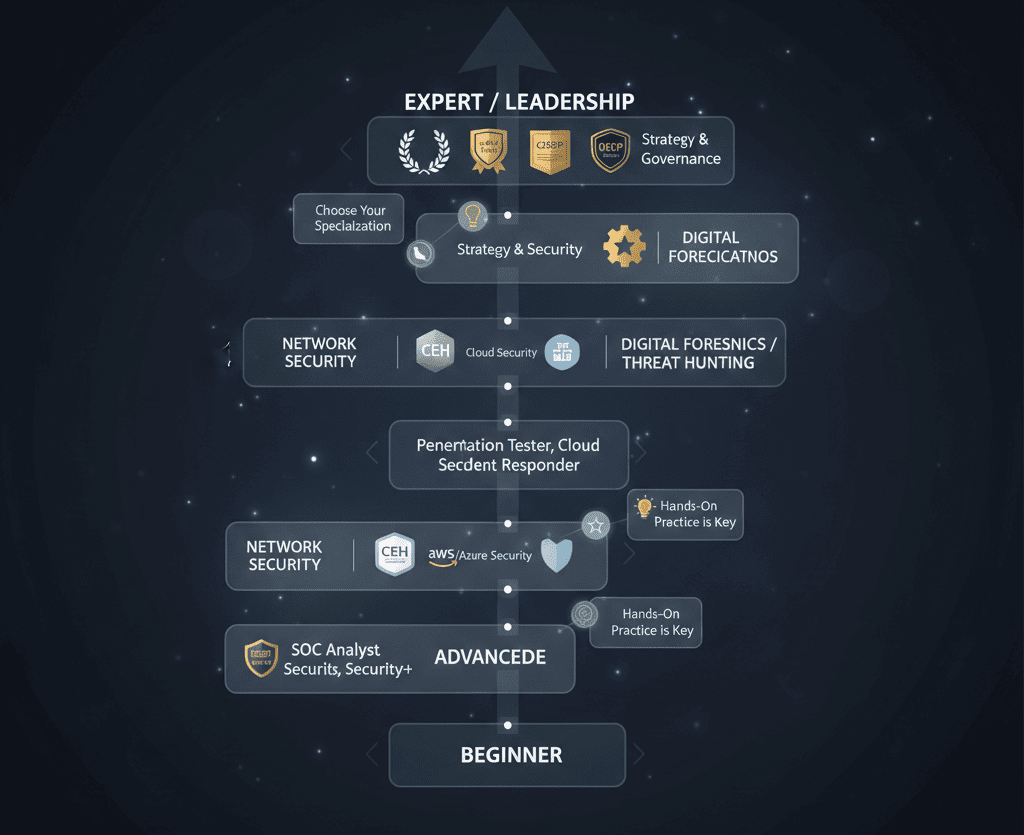
I did not start in cybersecurity. Like many of you reading this, I started with a general interest in technology, a curiosity about how things work (and how they break), and absolutely no idea how to turn that curiosity into a career. This post is the guide I wish I had when I started — honest, practical, and based on real experience rather than theoretical advice.
My Journey Into Cybersecurity
My first real exposure to security was accidental. I was building a web application for a university project and decided to test what happens if I put a single quote in the login form. The entire database dumped onto my screen. That moment — the realization that something I built was fundamentally broken in a way I had never considered — changed the trajectory of my career.
I went from “I want to build software” to “I want to understand why software breaks” overnight. I started reading about OWASP, watching hacking tutorials, and spending hours on TryHackMe and Hack The Box. The more I learned, the more I realized how vast this field is — and how many different paths you can take within it.
Getting Started: The Foundation
Free Resources That Actually Work
You do not need to spend money to learn cybersecurity. The best resources are free or very affordable:
Hands-On Platforms:
- TryHackMe — The best starting point. Structured learning paths from absolute beginner to advanced. Start with the “Pre-Security” and “Complete Beginner” paths.
- Hack The Box — More challenging. Start with the Starting Point machines, then move to Easy-rated boxes.
- PicoCTF — Capture the Flag competitions designed for students. Excellent for learning fundamentals.
- OverTheWire (Bandit) — Learn Linux command line through a wargame. Start here if you are not comfortable with the terminal.
- PortSwigger Web Security Academy — The single best free resource for web application security. Complete every lab.
Theory and Knowledge:
- Professor Messer (YouTube) — Free CompTIA Security+ and Network+ courses.
- NetworkChuck (YouTube) — Engaging introductions to networking and security concepts.
- OWASP Documentation — Read the Top 10, the Testing Guide, and the Cheat Sheet Series.
- Cybrary — Free courses on various security topics.
Building a Home Lab
A home lab is where you practice without consequences. You do not need expensive hardware — a laptop with 16GB of RAM and virtualization software is enough.
My Starter Home Lab:
├── Hypervisor: VirtualBox or VMware Workstation (free)
├── Attack Machine: Kali Linux VM
├── Vulnerable Targets:
│   ├── Metasploitable 2/3
│   ├── DVWA (Damn Vulnerable Web Application)
│   ├── VulnHub machines
│   └── HackTheBox/TryHackMe VPN
├── Defensive Lab:
│   ├── Ubuntu Server (Wazuh SIEM)
│   ├── Windows Server (Active Directory)
│   └── pfSense (Firewall/IDS)
└── Network: Internal NAT network (isolated from home network)
The key is to actually use it. Do not just set it up and admire it. Attack your own systems, break things, fix them, and document what you learn.
CTF Competitions
Capture the Flag competitions are the single best way to develop practical skills. They force you to think creatively, learn new tools under pressure, and solve problems you have never seen before.
Where to start:
- PicoCTF — Annual competition with year-round practice challenges. Perfect for beginners.
- CTFtime.org — Directory of upcoming CTF competitions worldwide.
- SANS Holiday Hack Challenge — Annual free challenge with excellent production quality.
My advice: Join a team. Solo CTFs are frustrating when you are starting out. Find a team on Discord, at your university, or through local security meetups.
Career Paths in Cybersecurity
Cybersecurity is not one career — it is dozens of specializations under one umbrella. Here are the major paths:
Offensive Security (Red Team)
You simulate real-world attacks to find vulnerabilities before malicious actors do.
Roles: Penetration Tester, Red Team Operator, Bug Bounty Hunter, Exploit Developer.
Skills: Web/network/AD exploitation, social engineering, tool development, report writing.
Typical progression: Junior Pentester → Penetration Tester → Senior Pentester → Red Team Lead.
Defensive Security (Blue Team)
You detect, respond to, and prevent attacks. This is where the majority of cybersecurity jobs are.
Roles: SOC Analyst (Tier 1/2/3), Incident Responder, Threat Hunter, Detection Engineer.
Skills: SIEM management, log analysis, malware triage, forensics, threat intelligence.
Typical progression: SOC Analyst Tier 1 → Tier 2 → Tier 3/Threat Hunter → SOC Manager.
Security Engineering
You build and maintain the security infrastructure — the tools, platforms, and pipelines.
Roles: Security Engineer, DevSecOps Engineer, Cloud Security Engineer, Security Architect.
Skills: Infrastructure as Code, CI/CD security, cloud platforms (AWS/Azure/GCP), automation.
Typical progression: Security Engineer → Senior Security Engineer → Security Architect.
Governance, Risk & Compliance (GRC)
You ensure the organization meets regulatory requirements and manages risk effectively.
Roles: GRC Analyst, Compliance Manager, Risk Analyst, Security Auditor.
Skills: Regulatory frameworks (ISO 27001, SOC 2, NIST, GDPR, PCI DSS), risk assessment, policy writing.
Typical progression: GRC Analyst → Compliance Manager → CISO.
Security Research
You discover new vulnerabilities, analyze malware, and advance the state of the art.
Roles: Vulnerability Researcher, Malware Analyst, Reverse Engineer, Cryptographer.
Skills: Assembly language, reverse engineering, fuzzing, protocol analysis, academic research.
Typical progression: Junior Researcher → Researcher → Principal Researcher.
Certification Roadmap
Certifications are not a substitute for skills, but they open doors — especially for your first job. Here is a practical roadmap:
Foundation (0–1 years experience)
- CompTIA Security+ — The industry-standard entry-level certification. Required for many government and DoD positions. Study time: 2–3 months.
- CompTIA Network+ — Understand networking before you try to hack it. Optional but valuable.
- Google Cybersecurity Certificate — Coursera-based, affordable, good for career changers.
Intermediate (1–3 years experience)
- CompTIA CySA+ — Blue team focused. SOC analysis, threat detection, incident response.
- eJPT (eLearnSecurity Junior Penetration Tester) — Practical, affordable pentesting cert. Good stepping stone to OSCP.
- BTL1 (Blue Team Level 1) — Hands-on blue team certification with practical exam.
Advanced (3+ years experience)
- OSCP (Offensive Security Certified Professional) — The gold standard for penetration testers. 24-hour practical exam. Extremely challenging and extremely respected.
- OSEP (Offensive Security Experienced Penetration Tester) — Advanced exploitation, AV evasion, Active Directory attacks. The next step after OSCP.
- OSWE (Offensive Security Web Expert) — White-box web application security. Source code review and exploit development.
- CISSP — Management-focused certification. Required for many senior and leadership roles.
My Honest Take on Certifications
Do not collect certifications for the sake of it. Each certification should serve a purpose — either opening a specific door or filling a specific skill gap. I have seen people with five certifications and no practical skills get outperformed by someone with zero certs who spent their time doing CTFs and building projects.
If I had to recommend just two: Security+ for your first job, and OSCP for proving you can actually hack.
Building Your Portfolio
In cybersecurity, what you can show matters more than what you can tell. Build a portfolio that demonstrates real skills.
GitHub Projects
- Security tools you have built (scanners, automation scripts, CTF solvers).
- Homelab documentation — Infrastructure as Code for your lab environment.
- CTF writeups — Detailed walkthroughs of challenges you have solved.
- Research — Vulnerability disclosures, malware analysis reports, security audits.
Technical Blog
Writing about what you learn has compounding benefits:
- Forces deep understanding — You cannot explain what you do not understand.
- Demonstrates communication skills — Critical for report writing and client interactions.
- Builds your reputation — People find your blog, share it, remember your name.
- Helps the community — Someone struggling with the same problem will find your post.
Write about CTF walkthroughs, tool tutorials, vulnerability research, and homelab setups. Consistency matters more than perfection.
Bug Bounty
Bug bounty programs let you test real-world applications legally and get paid for findings. Start with:
- HackerOne — Largest platform. Start with programs that have wide scopes and are beginner-friendly.
- Bugcrowd — Good programs with clear scopes.
- Intigriti — European platform with unique programs.
Even if you do not find bugs immediately, the process of testing real applications builds skills that lab environments cannot replicate.
Networking and Community
Cybersecurity is a community-driven field. The people you know will open more doors than the certifications you hold.
Twitter/X
Security Twitter is one of the most valuable resources in the field. Follow researchers, read threads about new vulnerabilities, and engage with the community. Start by following: @_JohnHammond, @NahamSec, @ippsec, @staborobot, @TechySpecky, @TCMSecurity.
Optimize your LinkedIn profile for cybersecurity roles. Share your projects, writeups, and certifications. Engage with posts from security professionals. Recruiters in cybersecurity are very active on LinkedIn.
Conferences and Meetups
- DEF CON — The largest hacker conference. Attend at least once.
- BSides — Local security conferences worldwide. Affordable and community-focused.
- OWASP chapter meetings — Free monthly meetups in most major cities.
- Local security meetups — Check Meetup.com for groups in your area.
Job Search Strategies
Crafting Your Resume
- Lead with skills and projects, not education (unless you have a relevant degree from a top program).
- Quantify everything — “Completed 50+ CTF challenges,” “Identified 12 vulnerabilities in bug bounty programs,” “Built SIEM monitoring 200+ endpoints.”
- Tailor for each application — Match keywords from the job description.
- Include your portfolio — GitHub, blog, and HackTheBox/TryHackMe profile links.
Interview Preparation
Technical interviews in cybersecurity typically cover:
- Scenario-based questions — “You see an alert for a brute force attack. Walk me through your response.”
- Tool knowledge — “How would you use Wireshark to analyze a packet capture?”
- Fundamental concepts — CIA triad, TCP/IP, common vulnerabilities, incident response phases.
- Hands-on challenges — Some companies give you a VM to hack or a log file to analyze.
My advice: Practice explaining technical concepts out loud. The ability to communicate clearly about complex topics is what separates good candidates from great ones.
Salary Expectations
Cybersecurity pays well, even at entry level, but varies significantly by region and specialization:
- Entry Level (SOC Analyst, Junior Pentester): $55,000–$80,000 USD.
- Mid Level (Senior Analyst, Pentester): $85,000–$130,000 USD.
- Senior Level (Lead, Architect, Manager): $130,000–$200,000+ USD.
- Specialized (Red Team Lead, Principal Engineer): $180,000–$300,000+ USD.
Remote work has equalized salaries somewhat, but high cost-of-living areas still tend to pay more.
Continuous Learning
Cybersecurity evolves faster than almost any other field. What you know today will be partially obsolete in two years. Build habits for continuous learning:
- Daily reading — RSS feeds, security newsletters (tl;dr sec, SANS NewsBites), Twitter.
- Weekly practice — One Hack The Box machine or one PortSwigger lab per week minimum.
- Monthly deep dives — Pick one topic and go deep. Write about it.
- Annual goals — One certification, one major project, one conference.
My Experience and Mistakes
Things I wish I had done differently:
- Started networking earlier. My first job came through a connection, not a job board.
- Written more. Every writeup I published opened doors I did not expect.
- Not chased certifications first. Skills first, certifications second. I learned more from 100 hours of Hack The Box than from any certification study guide.
- Asked for help sooner. The cybersecurity community is genuinely welcoming. People want to help — you just have to ask.
- Embraced the blue team. I was fixated on offensive security and ignored defensive skills. Understanding both sides makes you dramatically more effective at either.
Recommended Resources
Platforms
- TryHackMe — tryhackme.com
- Hack The Box — hackthebox.com
- PortSwigger Web Security Academy — portswigger.net/web-security
- PicoCTF — picoctf.org
- CyberDefenders — cyberdefenders.org
YouTube Channels
- John Hammond — CTF walkthroughs, malware analysis.
- IppSec — Hack The Box walkthroughs (the best on YouTube).
- NetworkChuck — Networking and security fundamentals.
- The Cyber Mentor — Practical ethical hacking courses.
- David Bombal — Networking, Python, security.
Books
- The Web Application Hacker’s Handbook — Dafydd Stuttard & Marcus Pinto.
- Penetration Testing — Georgia Weidman.
- Blue Team Handbook — Don Murdoch.
- Practical Malware Analysis — Michael Sikorski & Andrew Honig.
- The Art of Exploitation — Jon Erickson.
Final Thoughts
There has never been a better time to start a career in cybersecurity. The demand is massive, the work is intellectually stimulating, and the community is one of the most welcoming in technology. But it requires genuine effort — you cannot shortcut your way to competence in a field where the adversaries are sophisticated and relentless.
Start with the fundamentals. Build a lab. Break things. Write about what you learn. Connect with the community. The path is not always linear, and it is rarely easy, but it is absolutely worth it. Every expert you admire started exactly where you are right now — staring at a terminal, wondering what to type next. The only difference is they started typing.